“No BS. It’s got to work. No theory without implementation.”
That was the operating philosophy of Michael Stonebraker, according to the people who were there when Postgres was born. Walking into PostgresConf 2026, you could feel that exact same energy. Postgres isn't just surviving; forty years later, it is actively becoming the undisputed data foundation for the AI era.
For the team at Constructive, this year's PostgresConf was deeply meaningful. It was a chance to connect with the ecosystem, share our vision for the future, and learn from the legends who started it all.
Sitting Down with Legends: The UC Berkeley Roots
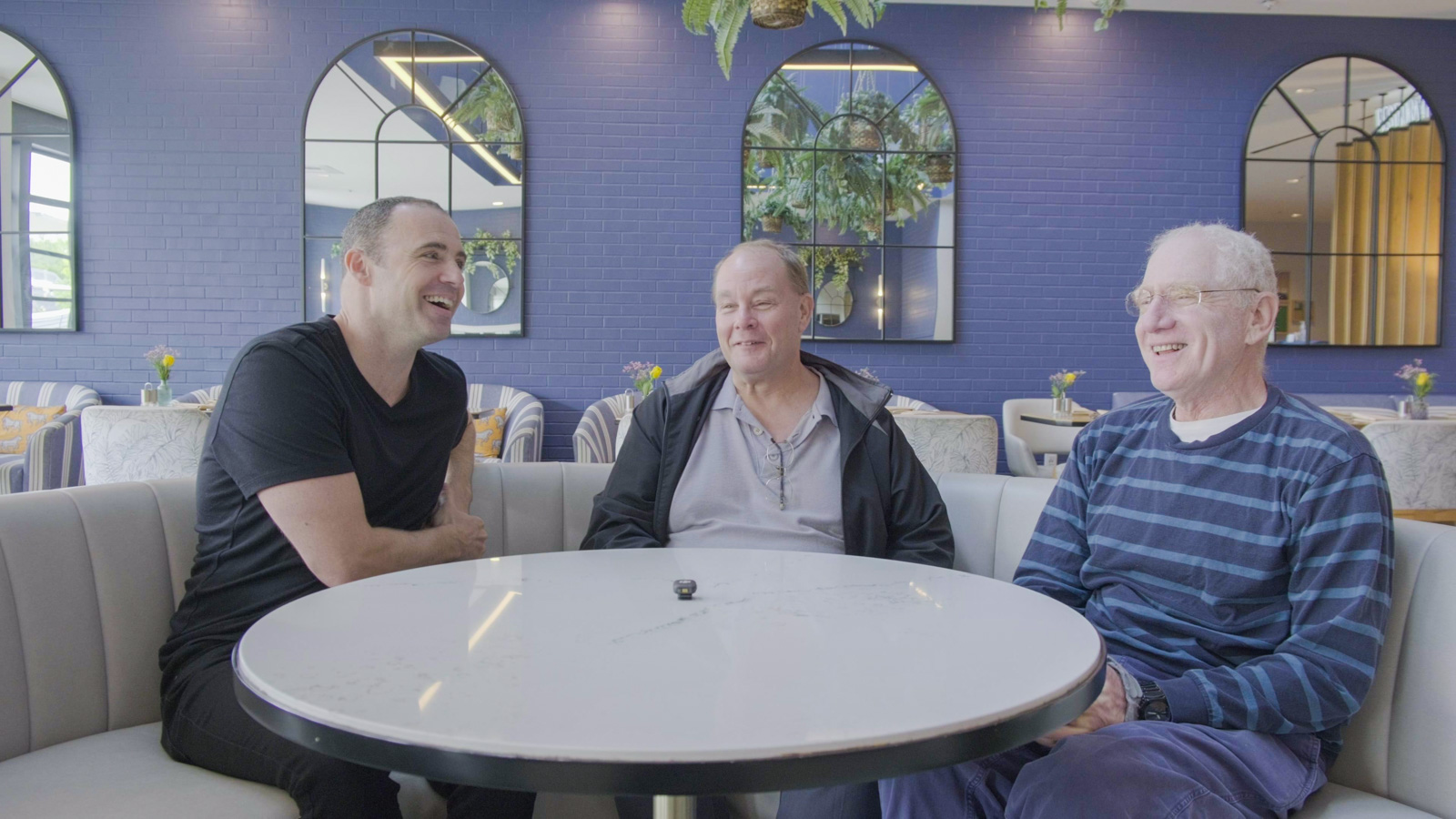
As a UC Berkeley alum, one of my absolute favorite moments of the conference was getting to sit down with Greg Kemnitz and Curt Kolovson, two of the original developers who built Postgres alongside Stonebraker.
Hearing their stories about the early days at Berkeley was surreal. They painted a vivid picture of a project where "surviving generations of grad students" required serious structural engineering and testing.
When I asked them how it felt to see Postgres dominate the world today, Greg pointed back to its core DNA: "It would never have become so widely adopted if it wasn’t great to begin with... One of the biggest reasons is extensibility. People can create extensions and add new data types."
Curt walked me through how he ended up on the project in the first place: "I knew Professor Stonebraker when I did my Masters at Berkeley. He was just starting Postgres, which was the Post-Ingres research project. So I became part of that." It’s the kind of story that reminds you Postgres wasn’t inevitable—it was a research project a small group of people decided was worth their lives.
It was a powerful reminder that the robust, massively scalable database we all rely on today was born from ambitious academic roots—and an ironclad commitment to making things that actually work.
Rewriting the Engine: Jonah Harris on Storage, VACUUM, and Bytecode
One of my favorite talks of the entire conference was Jonah Harris's session, "Rewriting the Postgres Engine." Jonah is the co-founder and CEO of Nextgres, and his résumé reads like a tour of database history: CTO of MariaDB and The Meet Group, founding engineer at EnterpriseDB, member of the Oracle OakTable Network, and longtime Postgres contributor. He built the personalization systems behind hundreds of millions of users at ParshipMeet and Noom—systems that outperformed TikTok's Monolith recommender.
The line that stuck with me most: "Logic running inside the database will always beat logic running a network round-trip away." As a heavy PL/pgSQL user, that one hit. It's the entire argument for why a serious database stack lives close to the data.
Jonah and I got to geek out in person about the same things he was unpacking on stage—vacuum mechanisms, storage engines, Datomic, and his work on a PL/pgSQL compiler that takes stored procedures all the way down to bytecode. One detail from the talk really stayed with me: PostgreSQL originally experimented with time-travel capabilities decades ago, and that history still shapes how the engine works today. Postgres is fundamentally append-only—it writes new versions of rows instead of overwriting them in place—which is why VACUUM exists at all. It puts Postgres in the same lineage as append-only databases like Datomic.
And here's the full-circle moment: Curt Kolovson—who was sitting right next to me—is the person who actually wrote the original VACUUM. The Berkeley team built the storage model whose implications we're still working through forty years later. I'm a fan of time travel and I'm influenced by Rich Hickey, so getting to learn the internals of that storage story from Jonah, with one of its original authors in the seat next to mine, was one of those conference moments you can't engineer.
The Future is Automated: Chatting with Luigi from dbtune
If my conversations with Greg and Curt were about honoring the past, my interview with Luigi Nardi, the founder of dbtune, was entirely about the future.
We had an amazing discussion about how machine learning and AI are revolutionizing database tuning and optimization. Luigi framed the intersection of AI and databases perfectly: "There is using AI to make Postgres better, and there is making Postgres better to support AI."
His work at dbtune pushes the envelope toward "autonomous Postgres," driving performance up to 10x by letting AI reason about tuning tasks that DBAs used to do manually. It perfectly aligns with Constructive's belief that the next generation of databases must be proactive and intelligent.
Scaling Postgres Horizontally: Sugu and Deepthi on Multigres
The other talk I have to call out was "Multigres: One stop PostgreSQL Management and Scaling", delivered by Sugu Sougoumarane and Deepthi Sigireddi of Supabase.
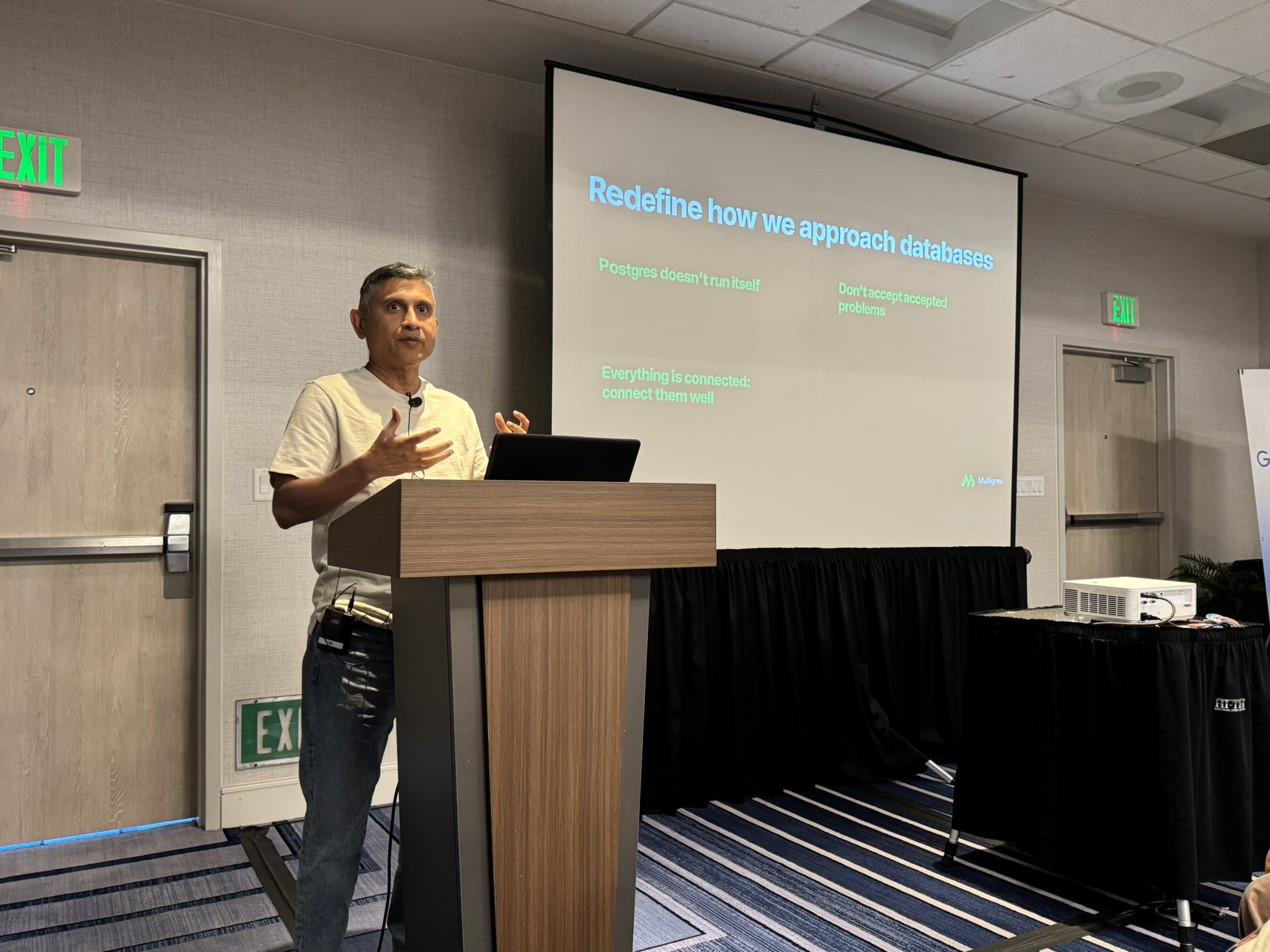 Sugu is co-creator of Vitess—the horizontal sharding system originally built at YouTube and battle-tested on some of the largest deployments on the planet. Deepthi came over to Supabase from PlanetScale, the commercial company behind Vitess. Now they're leading Multigres, an open-source project that takes the proven Vitess architecture and adapts it natively for Postgres.
I had a great lunch with them after the talk, and I really love what they're building. Native Postgres has been historically painful to scale beyond a single instance, and Multigres is a serious attempt to solve sharding and high availability without leaving the Postgres ecosystem. It's exactly the kind of substrate Constructive can build on, and we'll definitely be looking at how our platform can compose on top of it.
What’s Next
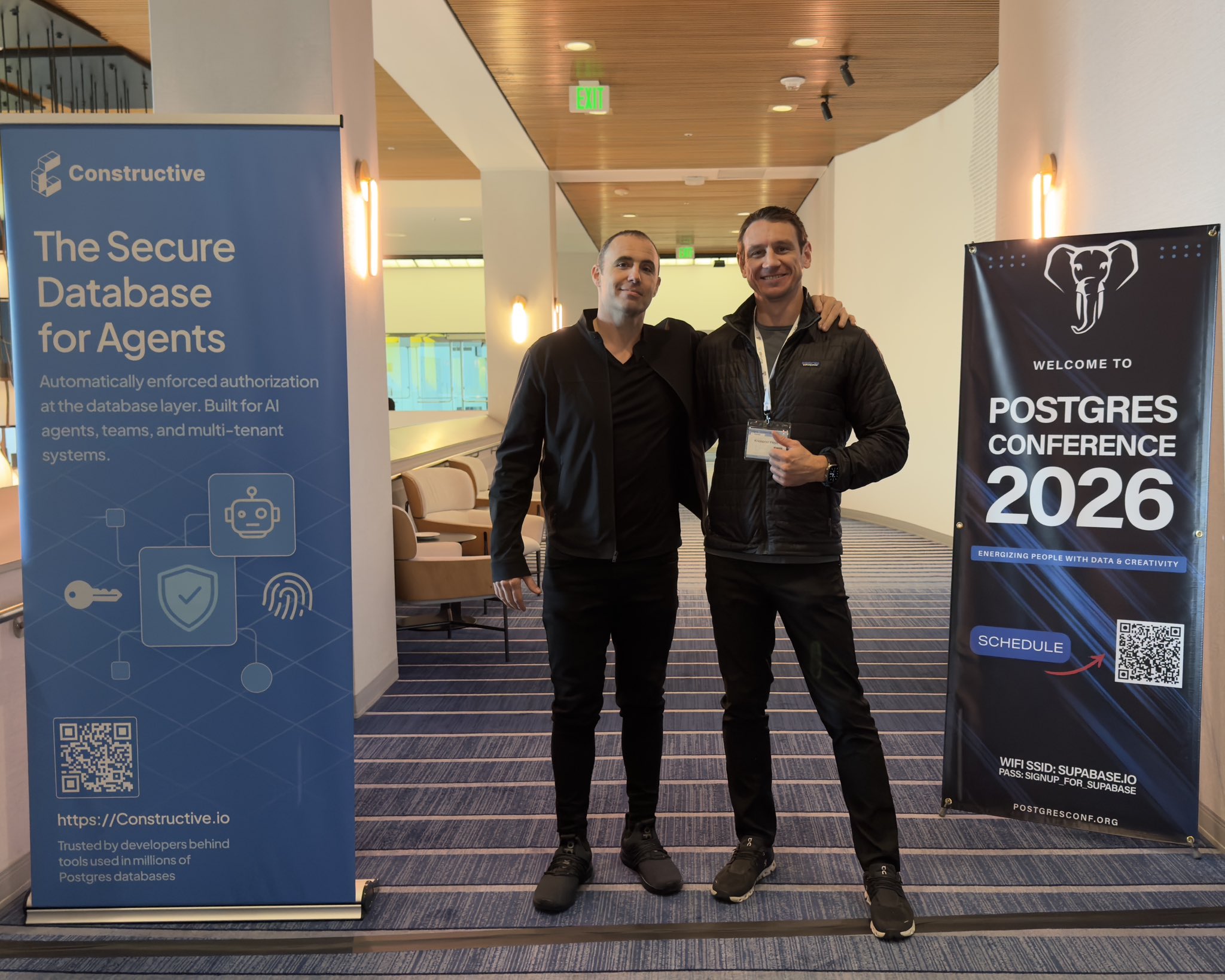
I left the conference feeling more validated and energized than ever. The hardcore Postgres community—the core maintainers and veterans who have seen every tech trend come and go—are incredibly supportive of what we’re building at Constructive.
A massive thank you to Joshua Drake and the entire organizing team for putting together such a phenomenal event. The elephant has come a long way since its days at UC Berkeley, but honestly? I think its best days are still ahead.
In Part 2, we’ll dive into my keynote on why "Trust Becomes Infrastructure" in the age of AI agents. Stay tuned!